Wednesday, September 25, 2013

Battle of Chancellorsville


Having driven the auto tour and walking much of the trails at the Chancellorsville Battlefield, I still had a difficult time putting it all together. The battlefield covered miles upon miles upon miles of terrain, much of which is now a four lane divided highway or wooded areas that were open fields 150 years ago. The “new” trees were a bigger problem for me as I could not get a feel for the battles or the maneuvering of the troops because my views were often blocked.  

Following the disaster at Fredericksburg, President Lincoln removed General Burnside and put in his place General Joseph Hooker. Fightin’ Joe Hooker, in my opinion, talked tough but didn’t follow it up with action. Hooker had a great plan to get behind the Confederate Army of General Lee, but at the first sign of difficulty, it seems Hooker would turn tail and run.

One of Hooker’s famous quotes after being given the command is “May God have mercy on Lee, because I will not.”

Leaving 30,000 troops with General Sedgwick at Fredericksburg to occupy Lee, Hooker moved the balance of his army west with the intention of crossing the Rappahannock River and close in on the Rebel Army from the west, while Sedgwick would move from the east. A brilliant plan.  Having crossed the river, Hooker started moving his troops east toward Fredericksburg. Lee, having learned of Hooker’s movement, split his forces, leaving some at Fredericksburg, and headed toward Chancellorsville. On May 1, 1863, they clashed.

With this resistance, Hooker elected to retreat back to the Chancellorsville area. He far outnumbered Lee’s troops, but none the less, backed away. He then formed a formidable defensive line at and around Chancellorsville. Chancellorsville, by the way, was not a town by rather an Inn located on the Orange Plank Road (current route 3).

During the night of May 1st, Lee learned that Hooker’s right flank was unprotected and this presented an opportunity for the Confederates to turn this flank and inflict serious damage on the Union Army. On May 2nd Lee, in a daring move, split his army of 60,000 troops and directed Stonewall Jackson to take his Corps on a 12 mile march over country roads and attack Hooker’s exposed right flank. Lee’s army was outnumbered 2 to 1 and with the orders he had given, was now outnumbered approximately 4 to 1 on the front.  The surprise maneuver worked for the Rebels as Jackson’s Corps crushed the right flank of Hooker’s as bloody fighting was taking place on the front and the left flank of the Union Army.

The night of May 2nd witnessed one of the most devastating events of the entire Civil War. As General Stonewall Jackson was doing reconnaissance, he was shot by one of his troops. He lost his left arm to amputation the next day, and 10 days later died of pneumonia as a result of his injury. General Lee, no doubt, lost his most reliable subordinate and Jackson was never adequately replaced.

Hooker, not understanding the importance of occupying Hazel Grove, the high ground of the battle, simply withdrew from this area. It was quickly taken by the Confederates who deployed artillery and was in an excellent position to shell the Union lines. Another example of Hooker not being a war time general under fire.

On May 3rd, J.E.B. Stuart was given command of Jackson’s Corps, resuming the relentless offensive against fortified Union positions. South of the highway, Stuart’s men attacked Fairview, an elevated clearing defended by nearly 40 cannon. In only five hours of fierce combat, more than 17,500 soldiers were killed, wounded, or captured. This amounts to one every second of fighting.

Eventually the Confederate artillery was shelling Chancellorsville, where Hooker had his headquarters. One of the shells that hit the house, as Hooker stood on the porch, caused a piece of wood to knock Hooker to the ground and dazed him. He  ordered a retreat and fell back about one mile toward the river.

At this time, Lee was able to pull a portion of his troops and send them seven miles east to the Salem Church area where General Sedgwick was approaching with his 30,000 troops from Fredericksburg. Sedgwick was defeated in this battle.

After uniting all his forces in Chancellorsville on May 5th, General Lee decided to again attack Hooker’s army with the intention of destroying it. As he moved  forward, Lee found only empty trenches as the Union Army had re-crossed the Rappahannock River during the night, thus ending this campaign.

This particular battle generated 18,000 casualties for the Union Army and 13,000 for the Confederates.

Once again, the Union Army far outnumbered the Confederate Army. But once again, General Robert E. Lee far outmaneuvered his Union counterpart and proved once again to be the far superior tactician.


Tuesday, September 24, 2013

Fredericksburg


Following General McClellan’s reluctance to pursue and destroy General Lee’s Army of Northern Virginia following the battle at Antietam, President Lincoln assigned the task of commanding the Army of the Potomac to General Ambrose Burnside. Burnside, at first, resisted this promotion based on his lack of confidence in his abilities, but eventually accepted.

The armies, at this time, were going into winter quarters; a period of the year where little to nothing was done due to weather and road conditions, making it nearly impossible to move large armies. The roads were always soggy and muddy and the wagons would constantly get bogged down.

Because of undue pressure from the press and Washington politicians, General Burnside elected to move his army to Falmouth, just across the Rappahannock River from Fredericksburg, Virginia and attack the city and move to attack the Confederate Army.

In order to cross the Rappahannock, Burnside had requested, from Washington, pontoon bridges. He had hoped to get across the river before General Lee could move his Confederate army to the area to resist and fight. But because of typical political red tape, the pontoons took longer than expected or was necessary. This delay allowed Lee to move his troops to Fredericksburg to confront the Union Army. 

Lee was able to secure the higher ground overlooking the city. With General Longstreet’s and General Stonewall Jackson’s corps, the Confederate Army controlled a front that stretched seven miles. Never the less, Burnside elected to be the aggressor and attack.

On December 11, 1862, Union troops shelled the town from Stafford Heights and then crossed the river on the pontoon bridges to challenge Lee’s Rebels which were holding the higher ground at Marye’s Heights, directly behind the city. On the 13th, the Union launched a two-prong attack. On the south end of the line, at Prospect Hill, they were able to break through Stonewall Jackson’s line for a brief but bloody moment. To the north, behind town, wave upon wave of Union infantry attempted to traverse an open field of 300 to 400 yards as they charged the Confederate line. In all, about 30,000 Union soldiers attempted to cross this field. The Rebels were well entrenched behind a stone wall which protected them as they stood in the Sunken Road. The Union soldiers had no protection and, as they ran the open field, were easy targets for both the Rebel infantry and their artillery placed on the higher elevation. No union soldier reached the stone wall.  Behind the Sunken Road was the elevation known as Marye’s Heights. The Union Army did not stand a chance. It was like a slaughter pen. The open field was littered with dying and dead in blue uniforms.

It was a decisive win for the army of General Lee and a painful blow to the Union war effort. This lop-sided defeat discouraged Union soldiers and intensified public debate regarding the war and the wisdom of emancipation. The Confederates, on the other hand, were established as an Army that would and could fight and win.

Chatham, a plantation home built in 1771 in Stafford Heights, served as the Union headquarters during the Fredericksburg campaign. It sat on nearly 1,300 acres. The house was also used as a hospital after the battle. Chatham, too, suffered. Union soldiers tore paneling from its walls and used it as firewood, then scribbled their names on the plaster beneath. Outside they cut down trees, trampled the gardens, and destroyed fencing. By the war’s end, Chatham was a scene of desolation. This is just one example of the devastation the citizens felt as a result of the Civil War.

There is a story of a young confederate, Richard Kirkland from South Carolina, who braved both enemy and friendly fire and carried water to the wounded Yankee soldiers lying on the open field during the night. This was truly an angel of mercy.

This is a national battlefield park that is worth the visit.

I also managed to spend some time in old historic Fredericksburg. What an incredible downtown they have kept. I walked along Caroline Street, block after block, just looking in the shops and visiting many antique stores. The architecture is still in place from the 1800’s and the city is maintaining that style. Fredericksburg is a cozy, friendly, architecturally inviting town and definitely worth the visit.


Thursday, September 19, 2013

Appomattox Court House and Sailor's Creek


It seems, to some degree, that I am visiting these Civil War sites in reverse order. After traveling to Lexington Where General Lee lived the last years of his life, I then spent some time at Appomattox Court House. For those of you unfamiliar with this famous location, it is the village where General Lee surrendered to General Ulysses S. Grant. Basically this ended the Civil War, even though there were still other Confederate armies in both the Eastern and Western theaters still bearing arms and fighting the Union armies.  Each army would eventually surrender on their own.

Lee was never the General in Charge of the entire Confederate Army. He was only the head of the Army of Northern Virginia, but because of his status with the entire Southern population, including the other Southern armies, his actions and words carried great weight. The surrender of the Army of Northern Virginia was not a popular action in the eyes of Jefferson Davis, but none the less, was the right thing to do. Davis supported the thought of going to the mountains with this army and fighting guerilla-style warfare. Lee knew this was wrong and that this tactic would only prolong the inevitable and cause more lives to be lost.

But I digress. Appomattox Court House was a small village that was comprised of a tavern, the county court house, a general store, the county jail, a couple law offices, and several residences. One of the residences was that of Wilmer McLean. This gentleman lived on the battlefield of the first Manassas battle four years earlier and moved his family to the Virginia country to get away from the war. How ironic that the war would end in the parlor of the house he bought to escape the war.  

To visit this village and the Wilmer McLean house was quite an experience. Several of the structures are originals, with a few being accurate reproductions. The court house had burned and was a reproduction of the original. The McLean house is also a reproduction for the most part. After the war, Mr. McLean went bankrupt, lost the house to the bank, and it was sold along with many of its furnishings. Some of the furniture that was in the parlor where Grant and Lee signed the surrender papers was bought by many of the officers that were in attendance at this event.  A speculator eventually bought the house in 1893 and disassembled it with the intention of shipping it to Washington, DC. He ran out of money before it was shipped and the house lay on the ground and eventually rotted and or disappeared. In the 1940’s , using the speculator’s plans and specifications and an archaeological dig, the house was reconstructed on the original site. Many of the original bricks were used in the reconstruction. Most of the furnishings for the parlor has been located and is on display, mainly at the Smithsonian. The furnishings now in the parlor are exact replicas.   It was certainly worth the trip to see and feel this place. Standing in the parlor, I could almost see Grant and his officers and Lee and his aide in the room.

I also visited Sailor’s Creek. This was the last major battle for Lee’s army before his surrender. It took place 72 hours prior to the Appomattox Court House meeting, as Lee was retreating in an attempt to secure rations for his troops and then to unite with Joseph Johnston’s army in North Carolina.

With constant rear guard action from the Union army in pursuit of Lee since Lee fled Petersburg, his army is starving and straggling. They continue to fight for Lee though. But with this final clash at Sailor’s Creek, Lee loses 7,700 men; nearly a quarter of his remaining army.

This battlefield site is not a National Park Service location and it is obvious. The state of Virginia owns the few locations in relation to the battle site, but most of the battlefield is privately owned. This site is not worth the time and effort to visit. The only sites available to see are the Hillsman House that saw the first major action of this battle. A short distance from the Hillsman House is Holt’s Corner where General Ewell sends the wagon train north on Jamestown Road to avoid the Union cavalry as the infantry continue their march west, the Lockett House that is the location of another bloody clash between Union and Confederate artillery and infantry, and the “double bridges” where the supply wagon train bogs down attempting to cross Sailor’s Creek. At this point about 300 wagons and ambulances are captured in addition to about 1,700 of General Gordon’s men. Ewell and Gordon were generals in charge of various brigades in Lee’s army.


Although there were other skirmishes prior to Lee’s surrender, this was the final major battle between the Army of Northern Virginia and the Army of the Potomac.

Wednesday, September 18, 2013

A visit to Lexington, VA


My sabbatical starts in the quaint little town of Lexington, Virginia. Although this village did not experience a major battle during the Civil War, it did see the Union Army occupy it and, more notably, it contributed to the Civil War in a different way.

Lexington was the home of Thomas J. “Stonewall” Jackson. Major Jackson, at the time, was an instructor at Virginia Military Institute (VMI). He taught Natural Philosophy, which is now called Physics, and military tactics. He was a prominent resident as well. Jackson was very active in his community, serving on the Board of Directors of the local bank, as well as in his church.

Jackson had moved to Lexington in 1851, ten years prior to the outbreak of the war and lived on campus for a portion of that time. Having married the daughter of the president of VMI, he and his wife lived in an apartment in the house with her parents. There they stayed until fourteen months later when she died during childbirth, as their baby was stillborn. Jackson mourned her death for years, walking to her grave nearly every day to weep.

Eventually, Jackson remarried and he and his second wife, Mary Anna, bought a home in town. This was the only house Jackson ever owned. He lived here from 1859 until his departure for the War in 1861. He never returned to this home. Jackson had one child, a daughter Julia, with Mary Anna.

The other notable tie to the Civil War is that it became the final destination for General Robert E. Lee. After the War, Lee was elected president of Washington College, later to be renamed Washington and Lee University. At first he rejected to offer, but finally accepted and held this position for five years, until his death in 1870.

Lee did much to improve and develop Washington College, including growing the enrollment from a few hundred to over a thousand students, improving the curriculum, and adding buildings. Two of the most impressive structures built during Lee’s presidency are the Lee Chapel and the Lee House, which is the home of the University’s president. General Lee lived in this house only one year preceding his death. Prior to this, he lived in the Lee-Jackson house as he contributed heavily to the design of his new home. The Lee chapel is beautiful and is used constantly. This Victorian chapel is the center of University activities since its construction in 1867. The statue of Robert E. Lee in the front of the chapel is impressive. I had always thought that this was Lee’s final resting place, but it is simply a horizontal statue. Mrs. Lee did not want another statue of Lee on his horse, Traveller, but preferred one of him as he appeared resting before battle. Lee, along with his family and other relatives, are buried in the lower level of the chapel.

While in Lexington, I had the opportunity to attend a dress parade at VMI. How exciting to see these young men and women in uniform and marching with terrific precision.


Lexington is a great small town that has preserved much of its history. The house architecture is marvelous. This was a wonderful way to start my travels. To see the beginning for General Thomas J. “Stonewall” Jackson and the end for General Robert E. Lee.

Tuesday, December 11, 2012

Election Time

I have never been involved in a presidential campaign as I was this past election. Not just keeping up on the issues of the campaign, or the rhetoric bantered between both parties, or issues that effect me personally. This election I volunteered at one of the local Tampa offices to lend my support and effort to help Mitt Romney with this extremely important election.

As we all now know, his campaign was unsuccessful. But I sure did learn and experience quite a bit.

Initially I was working just two nights a week, a couple hours each night, and a few hours on Saturday. This started in late September and quickly grew to many more hours each week and exploded to about 60 hours the last seven days of the campaign. I got caught up in the activities, the workload, and my belief in the candidate being the absolutely right man for the job.

I met some wonderful volunteers while working the campaign as well as having some quite interesting phone conversations during the six weeks I worked.

Originally my job was to work the phone bank. When I first started I was calling throughout the state of Florida with the sole mission of getting voters interested in voting by mail - the absentee ballot as it is called.  This activity was fairly calm and boring with one exception. Early on I spoke with a woman that, after identifying that I was volunteering for the Romney campaign, proceeded to yell and scream at me regarding how she hated Mitt Romney. Even though I wanted to pursue her anger and ask what he had done to her, I knew that would be pointless. I politely thanked her for her time and hung up. Gee, I wonder what party affiliation she was associated with.

After a couple nights of doing this, I was promoted(?) to making recruiting calls. I would spend the evenings calling registered republicans to ask if they would give of their time to help with the phone banks or neighborhood walks/door knocking. This, too, was fairly routine and boring, although for me it posed some challenge as I had to ask someone to help and donate their time. I am not comfortable with this. But actually I became somewhat good at this. Even though I had a script to work from, through trial and error, I figured out what to say to get better responses. No crazy phone calls with the recruiting calls, but it is amazing how many people are out of town on weekends when you ask for their time.

As election day drew near and I was not recruiting on the phone, our mission with phone calls changed. We now calling registered republicans and independents asking if the Republican Party and Mitt Romney could count on their support for the election. The volunteers also grew tremendously during this time. By the middle of October we would have in excess of 100 callers on any given Saturday and even more doing neighborhood walks. The intensity and dedication was impressive. The phone calls were still being made statewide while the door knocking was in the greater Tampa area. I was now recruiting during the week and phone banking on the weekends, which grew from a few hours on Saturday to a larger time on Saturday and more hours on Sunday.

Because of the intensity of this election in such a heated, battleground state as Florida, calls to potential voters became constant and overwhelming for many of them. Some became irritable, which I understand, but the calls were necessary. We were now pursuing early voting in addition to the absentee balloting.

I spoke with many, many people during this phase. Most were pleasant and understanding of what we were attempting to do. I often heard "thank You for volunteering your time" from the individual I called. As November 6 grew near though, the general public became very tired of the calls so I started hearing all kind of comments.

*I had one person asked me who Mitt Romney is. And he was serious with that question. Obviously I didn't need to continue that conversation.
*When I asked another person if we could count on his support on election day, he laced his response with the "F" bomb. He said he would vote for "F'ing Obama if we didn't quit F'ing calling him every F'ing day. That call ended abruptly also.
*I spoke to people that didn't know when election day was.
*I spoke with a gentleman who told me he just got home from the hospital for leukemia treatment, that he was dieing but was voting for Romney.
*I had another call where a woman answered. I asked for her husband and she informed me that he had just died last week but she assured me that he sent his ballot in and that he voted for Romney.
*Another woman informed me that she and her husband were both voting for Mitt Romney. She then told me that she told her children if they did not vote for Romney she was taking them out of her will. And she also assured me she would do just that.
*When door knocking, I had one man immediately respond with "What the hell do you want". I hadn't said a word, but I did have a Romney hat on.

Through the course of the six, or so, weeks that I worked at the campaign office, we had news crews from England and Australia stop by. We also had USA Today, The New York Times, Fox News, ABC, and all the locals come by to see what we were doing. I've heard that I was on a Fox News clip showing the last Romney Rally.

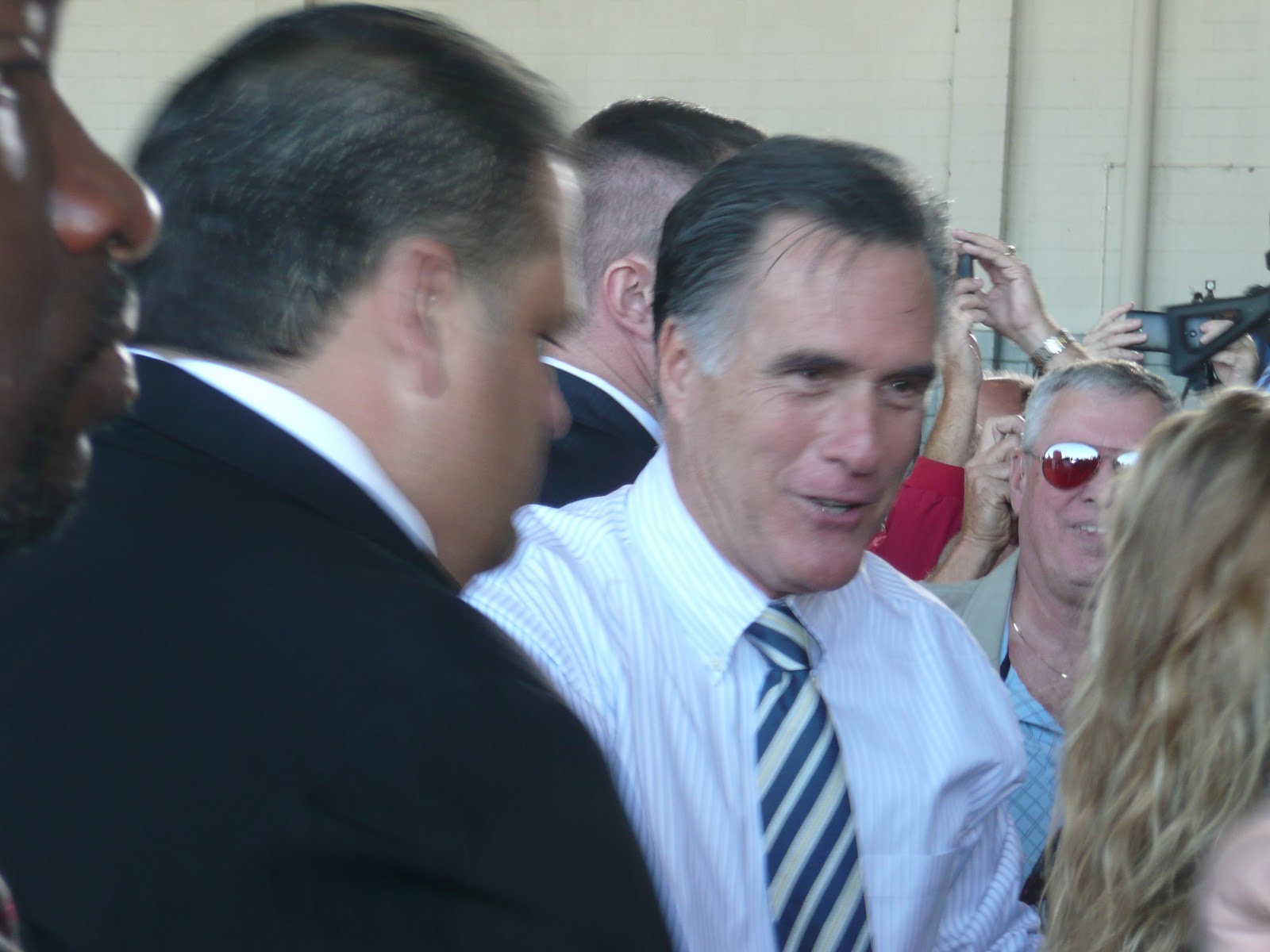
Because of my efforts on the phones, training other volunteers on the phones, and doing a week of door knocking, I was given a VIP pass to the final two Romney Rallies in the area. It was great. On both occasions I had the privilege of shaking Mr. Romney's hand and at the second one I spoke with him for a minute. I met Senator John McCain, Senator Marco Rubio, State Attorney General Pam Bondi, former Florida Governor Jeb Bush, and Congressman Connie Mack. I was also invited to the Republican Election Night party at the downtown Hyatt. Unfortunately it turned out to  be not much of a party.

 Even though Mitt Romney was not successful in his bid to win the presidency, I feel like I gave my all and I don't have to worry whether I could have done more. Again, it was quite the experience and I met some wonderful people.


Monday, November 12, 2012

A trip back to Sevierville

It's been quite some time since I've written a blog. I guess I've been busy keeping house or I've settled into a quiet, simple life.

In early September I traveled to Sevierville to play in a golf outing. Audrey Yates and Smoky Mountain Title was kind enough to sponsor a four man team. The only problem I had was that I traveled to Sevierville about a week early. I didn't pay much attention to the date Audrey sent me and just went.

This worked out well though, in the long run. It allowed me to spend about four days experiencing one of my passions. I drove to Murfreesboro, Shiloh, Corinth MS., Clarksville/Nashville, and Chattanooga . I was able to visit Civil War battle sites at each of these locations.

First on the list was Stone's River in Murfreesboro, TN. This marked the beginning of the Union taking control of Middle and Western Tennessee and essentially splitting the Confederacy in half. I spent the better part of a day touring the site, spending time at the visitors Center, and getting in and out of the car to get a feel for the battle and to read all the markers. 

From here I drove about four hours and located the Shiloh battle site. It was late in the day and I could find nowhere to spend the night, so I had to travel about an hour north to near Jackson, TN to find a room. Knowing that the Shiloh site was extremely large, I headed out early the next morning. While at Stone's River I spoke with another Civil War tourist and he advised me to visit Corinth, MS before Shiloh. At that time, Corinth was a strategic rail center for the South, and would later fall to the Federals. This would lend some insight as to the reasoning behind Confederate General Sidney Albert Johnston's attempt to smash Federal General U.S. Grant's army encamped at Shiloh. Getting to Corinth and visiting the center added about three hours to my trip, but it was certainly worth it. From here I traveled back to the Shiloh battle site. After touring the visitor center - reading, viewing artifacts, and watching a film - I visited the U.S. Military Cemetery where many of the Union soldiers that lost their lives at this battle are buried. This was an extremely moving experience. I then jumped in the car and proceeded to spend the next five hours driving the auto tour, getting out and reading the markers, walking some of the areas that were highlights in this horrific two day battle, and drinking in the feelings that flow through this site. Various locations that were highlights of this battle is the Shiloh Church itself that changed hands twice; it was used as both Union General William T. Sherman's headquarters, and after being overrun by Confederates, it was used By Confederate General Pierre G.T. Beauregard's headquarters until it was taken back on the second day of battle. I also walked Bloody Lane, the Hornet's Nest, Bloody Pond, the Peach Orchard, and the site where General Sidney A. Johnston was shot and later died. In my opinion, General Johnston was the best Confederate general of the western theater.


From here I traveled north to Clarksville, TN - north of Nashville. Getting to my room about 9 PM, I planned my next day and rested. Early the next morning, I backtracked once again and went to visit the Fort Donelson Battle site. This was also a strategic battle as this fort along with Fort Henry allowed the Confederates to control the river traffic. These forts were located on the Cumberland and Tennessee Rivers, respectively, and were vital to river movement of troops and supplies in the western portion of the Civil War. Fort Henry fell easily to General Grant and the naval support courtesy of Flag Officer Foote. This was made possible with the nearly complete evacuation before the battle due to difficulty in defending the fort. Fort Donelson was a different story. The defense of this fort was prepared for much better. And the U.S. Navy did not have the same success as it did at Fort Henry. The confederate cannon was better positioned and not easily reached by Flag Officer Foote's gunboats. Eventually the gunboats, after sustained much damage, withdrew. The Federal infantry was also stymied after a day's battle, but for some odd reason, the two confederate generals, General John Floyd, who was in command of Fort Donelson, and General Pillow, second in command, pulled the confederate troops back into the fort. Under the cover of darkness, these two generals along with the confederate cavalry led by General Nathan Bedford Forrest escaped the fort which was surrendered the next day, the Confederates losing about 13,000 troops. 

From here, with time on my hands, I drove to Chattanooga to visit Lookout Mountain and learn about "The Battle Above the Clouds". Again, arriving in the evening, I checked into a hotel and planned my next day.


Following the Federal retreat at the Battle of Chickamauga, these troops under the leadership of General Rosecrans occupied Chattanooga. Confederate General Braxton Bragg followed them to Chattanooga and proceeded to lay siege to the city in an attempt to force a surrender. Bragg stationed troops on Lookout Mountain overlooking the city, to the east in an area referred to as Missionary Ridge, along with various troops scattered to the west. Eventually the siege was broken by General Grant's movement of Federal troops crossing the Tennessee River near Moccasin Bend and creating "The Cracker Line". In addition, his troops easily took Missionary Ridge and charged up Lookout Mountain. Due to heavy fog hanging around and over Lookout Mountain, to view the battle from the base of the mountain was impossible; thus the term "The Battle Above the Clouds".  

Thus, in only four days I travelled to some of the most important battle sites in the western theater of the Civil War; and one of the bloodiest of the entire war - Shiloh.

Consider this your American history overview lesson for the month. The Civil War really is one of the most interesting periods in our country's history. So much came about in our great country because of this conflict.

Oh yeah, I did get to play golf. We had a great time but didn't play very well. It's really a social event for most of us.